PhDs wear many hats.


On social media and hiring discussions across industries, a persistent myth prevails: “PhD research experience isn’t real experience” or “Academic experience doesn’t translate to industry”.
If you’re reading this and saying, “That is NOT true, people aren’t really saying that. Where’s the proof?”, here’s a receipt from an actual job post on LinkedIn during the week of August 5th, 2025:

Strange: Academic experience is a disqualifier for a job requiring independent research?
This reductive narrative not only undermines the rigorous training that doctoral-level researchers undergo but also minimizes organizations’ pool of highly trained professionals whose expertise has become more critical as AI tools overtake routine tasks and necessitate higher-level, critical and conceptual thinking.
Contradiction: If PhD-level training is so irrelevant to industry, why are PhD-level agents so costly? Just a hunch, but maybe because PhD training is, in fact, valuable.

As AI floods every nook and cranny of society, value will be placed on complex problem-solving, dealing with ambiguous problems, leadership, adaptability and deep analytical thinking, which are all core components of PhD training in research-heavy programs. Despite what they’re telling it, this is something that AI will continue to falter at. As AI-agents continue to fail and move passed the “hype cycle” (as CEO of Amazon, Andy Jassy was quoted), it is likely PhD-level experience will continue to rise as PhD-agents will be realized ineffective compared to the real-thing.
Note: The focus of this blog is on PhDs in STEM (Physics, Biology, Genetics, Biomedical sciences, Data Science, Engineering, Statistics) and STEM-adjacent/emerging fields (Cognitive Neuroscience, Behavioral Science, Computational Social Science, Cognitive Psychology, Quantitative Psychology and Developmental Cognitive Neuroscience).
The prevailing assumptions suggest that PhD holders are:
The PhD’s rigorous training purpose is for candidates to break out of the circle of current knowledge and move their field forward. This focus doesn’t imply abilities are orthogonal to non-academic missions, they’re simply more aligned with academic priorities that emphasize narrowly focused research and robust experimental frameworks. I think Matt summarized it well in this illustration, whereby PHDs break through the corpus of human knowledge.
These assumptions reveal a fundamental misunderstanding of what PhD training actually entails. Doctoral programs, particularly in STEM fields and applied disciplines, function as intensive professional development programs that train precisely the skills modern organizations need most. As noted by Yann LeCun, unlike LLMs which retrieve information, PhDs invent solutions to problems.
Are there some narrowly focused PhDs? Yes. Are there some who lack certain skills? Yes. But should the entire category be labeled as “not having any relevant experience”? No. This is precisely what interview processes are for, understanding what candidates actually accomplished versus what they claim. The challenge of overstating qualifications isn’t unique to PhDs; it affects all applicants. In fact, “resume inflation” is getting worse. (Sorry, Gerald, you can’t have 6+ years of experience in genAI models when they’ve only been around for 3-4 years.)
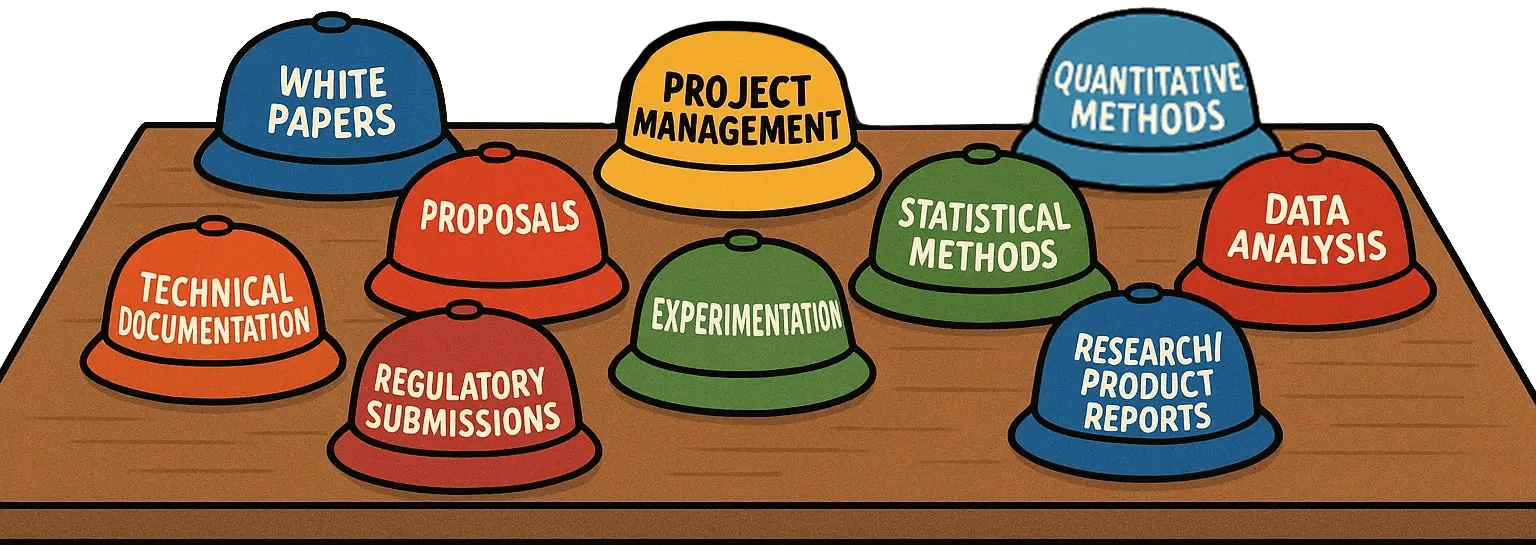
PhD candidates manage complex, multi-year projects with competing deadlines, encompassing:
I knew PhD candidates who managed projects requiring building entire real-time data architectures and running rigorous, complicated, multi-modal brain imaging analyses. This involved designing protocols, piloting imaging acquisitions, A/B testing experiments, managing ethical reviews, participant recruitment, data processing, statistical analytics and writing technical reports.
The PhD experience fundamentally involves encountering ambiguous problems with multiple design, analytic, and experimental options, requiring hard decisions and solution development:
This translates directly to troubleshooting technical issues, handling ambiguous business scenarios, managing competing stakeholders, optimizing processes and driving innovation.
Contrary to the “ivory tower” stereotype, PhD training heavily emphasizes communication:
As AI automates routine tasks and ChatGPT tries to figure out how many r’s are in strawberry, there’s a premium on high-level conceptual thinking. PhD training specifically develops:
The skills PhD programs develop, often mislabeled as “soft”, are precisely those hardest to automate and most valuable in knowledge work (see article from Harvard Business Review). PhD training prepares professionals to:
Modern PhD training, particularly in interdisciplinary fields, develops:
Methodological Flexibility: A PhD in computational biology might use machine learning, statistical modeling, laboratory techniques and field research—all transferable to business analytics, product development, or operations optimization. A Psychology PhD may use propensity score matching and hierarchical modeling of clustered data, skills that directly translate to tech company problems (e.g. networks)
Domain Adaptability: Research increasingly requires connecting insights across fields. A Developmental Psychology PhD integrates development, cognitive psychology, community factors, genetics, neuroscience and social policy.
Rapid Learning: PhD training develops the ability to quickly master new domains. The same skills used to understand cutting-edge research literature apply to rapidly comprehending new industries, technologies or business models.
When I started my PhD program, I entered a team in year two of a five-year, multi-million dollar NIH grant. The team needed someone to establish data management workflows and analytic pipelines for behavioral and brain imaging data to answer key experimental questions for stakeholders.
My program officially started September 1st, 2017. I was in Ann Arbor working on research by August 7th. When I officially started, I had a conference deadline in early October. This meant I had to adjust to the new environment, handle coursework, get acquainted with data, and prepare high-impact research for a flagship adolescent research conference.
All for fractional pay.
Consider a typical day during my second year:
7:30-8:30 AM: Reading published work, reviewing statistical methods in R before classes (Literature review, technical documentation, programming proficiency)
9 AM-12 PM: Statistics courses and classes on developmental/neuroscience theory (Continuous learning, technical skill development, domain expertise)
2-4 PM: Data management workflows, statistical analyses, reports, lab meetings, coordinating with scientists (Data engineering, statistical analysis, technical writing, stakeholder management)
4-5 PM: Teaching undergraduate courses and office hours (Project management, public speaking, mentoring)
7-9 PM: Preparing reports, writing proposals, working on data workflows to meet deadlines (Grant writing, technical documentation, deadline management)
9 PM-12 AM (some days): Troubleshooting Linux/Bash, R and Python code to resolve data/model/workflow bugs
Weekends included conference preparation, literature review, debugging code, and building statistical models for team deadlines.
This isn’t academic busy work, it’s intensive professional development that mirrors and often exceeds the complexity of senior-level industry roles.
This environment develops professionals who survive high-pressure situations with minimal monetary rewards, creating individuals who:
Not all PhD experiences are identical. Transferability depends on:
Program Structure: PhDs with industry partnerships, applied research focus, and emphasis on quantitative skills may have more obviously transferable experience.
Individual Initiative: Some candidates actively seek diverse experiences (collaborations, additional training, multiple projects), while others remain more academically focused.
Field Relevance: A PhD in AI or data science may have more obvious industry applications than cognitive neuroscience, but both develop valuable analytical and communication skills.
Rather than dismissing PhD experience categorically, organizations should evaluate candidates individually:
PhD holders bring unique abilities in:
Organizations need professionals capable of:
PhD training develops comfort with long-term, complex projects—increasingly valuable as business cycles extend and competitive advantages require sustained effort.
Reframe evaluation criteria: Instead of “Do they have industry experience?”, ask “Do they have relevant problem-solving experience?” or “Can they learn missing skills quickly given their demonstrated abilities?”
Design appropriate assessments: Test analytical thinking, communication, and project management rather than industry-specific knowledge. If they lack PowerBI, Tableau or SQL, one week of online training plus 1-2 weeks on-the-job exposure will suffice.
Leverage learning ability: PhDs often master industry-specific knowledge faster than industry professionals develop analytical depth.
Translate your experience: Frame research projects in business terms (ROI, stakeholder management, resource optimization). Make your resume speak to recruiters spending <20 seconds reviewing it.
Quantify impact: Use metrics demonstrating scope and significance such as time saved, community impact, research team impact.
Highlight transferable skills: Explicitly connect academic experiences to business applications.
Seek bridge experiences: Consider summer internships or, when that is not possible, incorporating industry tools into your research.
Based on LinkedIn job postings from August 2025, common requirements include:
Incorporate and highlight how you leveraged these in your roles and projects.
For example, based on “Data Science”, “Quantitative Research” and “UX Research” terms on job posts from LinkedIn between August 5th to 28th in 2025, here are the most common terms (of course, this will change with time):

As we continue into an uncharted territory of rapid technological change and AI adoption, PhD training skills may become increasingly valuable. Organizations dismissing doctoral experience as “not real” aren’t just perpetuating unfair bias, they’re overlooking significant competitive advantages and limiting themselves with outdated filtering tools such as leetcode and “industry-only” gatekeeping.
The question isn’t whether PhD holders can contribute to industry success, but whether organizations are willing to recognize and harness the unique skills doctoral and post-doctoral research fosters. In an economy increasingly rewarding deep thinking, adaptability, continuous learning, innovation and resilience under uncertainty, PhD holders aren’t just qualified for industry roles, they may be uniquely positioned to excel.
It’s time to move beyond the simplistic “academic versus real world” dichotomy and recognize PhD training for what it actually is: intensive professional development producing analytically sophisticated, resilient and adaptable professionals well-suited for both academic and industry workforces.
I can teach Python, data management pipelines, SQL syntax, PowerBI/Tableau, all of these technical skills in a matter of weeks if you have prior experience with software like R or Excel. But I cannot teach critical thinking, rigorous research methodology, complex problem-solving, and advanced communication skills in less than years of dedicated practice. These “soft skills” represent the hardest-to-replicate value of doctoral training. You cannot replace 5+ years of rigorous intellectual development with a 3-month bootcamp or internship. It is simply not practical and is not supported by any neural evidence (neurons that fire together wire together, but not that fast…).
Are you an organization looking to tap into this underutilized talent pool, or a PhD seeking to translate your skills for industry roles?
Share your experiences and let me know what elements of the narrative you do and don’t agree with.